When God Turns Wounds into Blessings

The film
Storyboard
Scene 1
1 shot · 10sShot 1 · wide · 10s
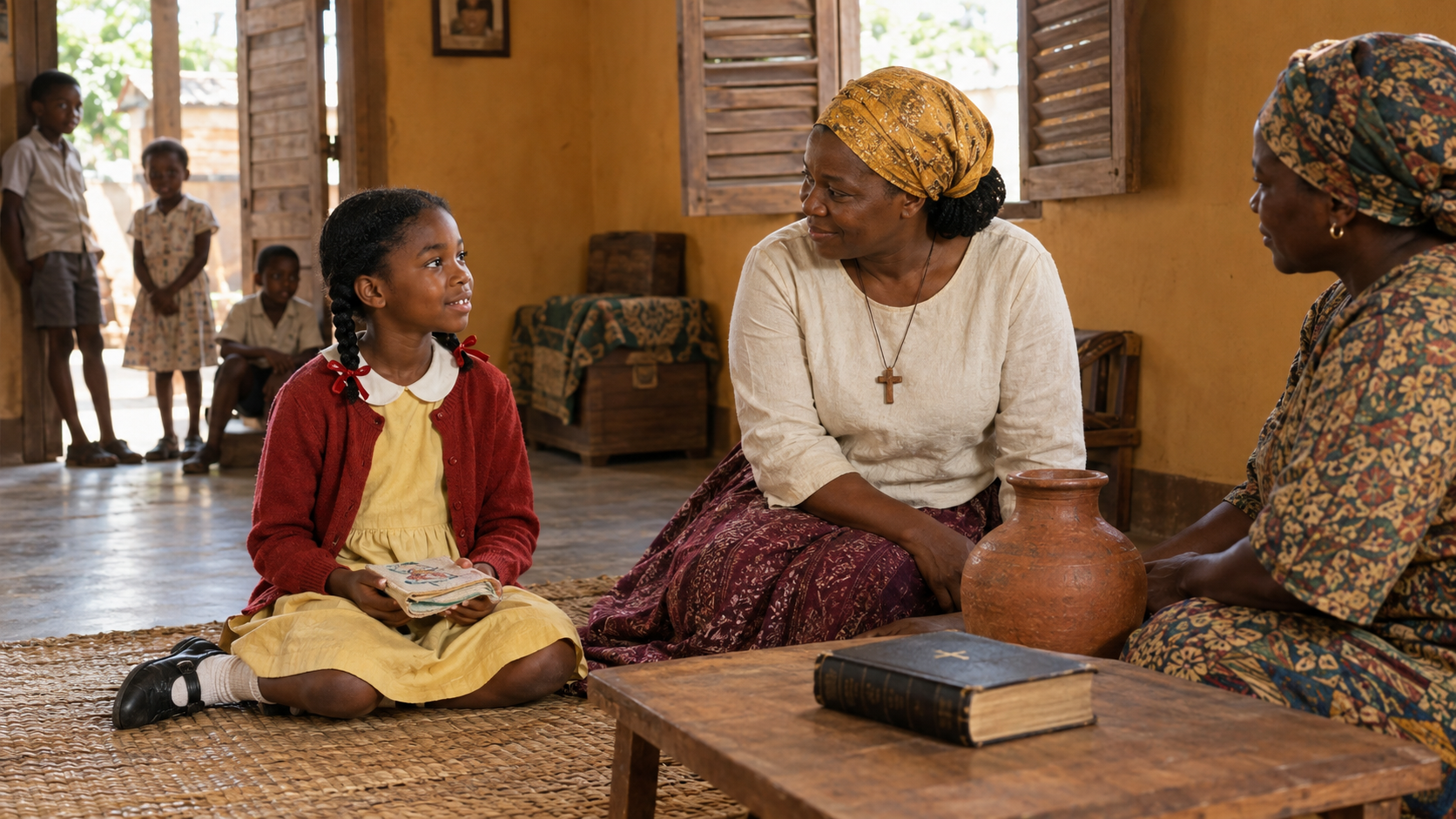
The young narrator watches her mother serve someone else while the crowded family home carries the life of ten children. She wants her mother, but begins to understand that service fills the household.
- Young Narrator: Mama, I have a little story to tell you.
- Mama Jacky: I am listening, my child. Give me one moment.
Scene 2
2 shots · 18sShot 2 · over-shoulder · 12s
The Narrator opens the family Bible at the desk, with the face-down photograph beside it.
- I was born into a family devoted to serving God. There were ten children in our family, and I was the seventh.
- Not rendered yet
Shot 3 · medium close-up · 6s
The photograph reveals the Kinshasa family, and the Narrator accepts the memory as part of her story.
- God was already writing. I simply could not yet read the lines.
Scene 3
2 shots · 23s- Not rendered yet
Shot 4 · medium · 12s
The Daughter stands beneath the church veranda, holding her pregnant abdomen as the leaders' decision begins to close around her.
- At the age of twenty-one, I became pregnant. From that moment on, my life changed completely.
- Not rendered yet
Shot 5 · medium close-up · 11s
The leaders impose their decision, and The Daughter holds the document against her abdomen while searching the chapel doorway for another answer.
- In that context, my spiritual leaders made a decision: I had to marry the father of my child.
Scene 4
3 shots · 38s- Not rendered yet
Shot 6 · close-up · 13s
The Narrator writes in the notebook and then looks up, turning private memory toward an unseen listener.
- A pregnancy should never force a woman to enter a relationship, or even to remain in one with the person responsible for the pregnancy—especially when it was unexpected.
- Not rendered yet
Shot 7 · medium close-up · 13s
She sets down the pen and draws the Bible closer, rejecting marriage as a remedy for appearances.
- Marriage is not a punishment. Marriage is not a tool for saving appearances. Marriage is a covenant. It must be built on truth, responsibility, maturity, respect, and safety.
- Not rendered yet
Shot 8 · close-up · 12s
The Narrator asks the decisive question and closes the Bible, turning pain into a boundary for future generations.
- Sometimes we need the courage to ask a much more important question: Is this union truly good and safe for this woman and this child?
Scene 5
2 shots · 19s- Not rendered yet
Shot 9 · wide · 10s
The Daughter adjusts the newborn and looks across the empty courtyard, waiting for support that does not come.
- I was young. I needed guidance. I needed someone to listen to me. I needed help discerning what was right.
- Not rendered yet
Shot 10 · medium close-up · 9s
She finds almost nothing in the cloth bag and holds the baby more securely as the absence of help becomes unmistakable.
- What can someone do in such distress if the Lord does not give them the strength to hold on?
Scene 6
1 shot · 13s- Not rendered yet
Shot 11 · medium · 13s
The adult narrator faces the full consequence of the union: three children and one of the most painful periods of her life. She does not erase the pain, but places the names of Jedidja, Jason, and Joyce beside it.
- I eventually entered a union that would become one of the most painful periods of my life. I became the mother of three children: Jedidja, Jason, and Joyce.
Scene 7
1 shot · 5s- Not rendered yet
Shot 12 · close-up · 5s
The narrator reaches the unfinished edge of her testimony. She looks toward the future rather than pretending the pain has been resolved, holding the belief that even this man may have been part of a larger purpose she is only beginning to understand.
- Today, I believe that this man was able
The story
Original input — click to expand
“When God Turns Wounds into Blessings CHAPTER 1 — MY ROOTS I was born into a family devoted to serving God. There were ten children in our family, and I was the seventh. Much of my childhood was spent in Kinshasa, in the Democratic Republic of the Congo, before I left the country at the age of twelve to move to Belgium with my parents. Growing up in a family devoted to ministry means growing up in a particular world. You learn faith, prayer, service, and sacrifice at a very young age. But when you are a child, you do not always understand everything your parents’ calling entails. My mother, whom I affectionately called Mama Jacky, was deeply committed to serving God. She devoted much of her time to the people she supported. Like many children of people in ministry, we sometimes needed her when she was with someone else. We wanted to tell her our little stories. Our fears. Our joys. Our difficulties. We simply wanted our mother. Looking back, I now understand that my mother loved us deeply. But I also understand that certain childhood experiences helped shape the woman I became. I did not yet know that God would one day use some of my wounds to develop in me a special compassion for wounded people. Nor did I know that my mother’s story would one day play an unexpected role in my own meeting with the man who would become my husband—somewhat like Jonathan, who spoke to his son about David without knowing that an alliance forged in the shadows would one day bless his own household, especially his son Mephibosheth, who had been orphaned and left disabled in Lo-debar, with no hope of a better future. God was already writing. I simply could not yet read the lines. This is often how God works: He begins writing a story long before we understand its meaning. The deepest roots, even painful ones, sometimes become the soil in which a future harvest grows. “Before I formed you in the womb I knew you.” — Jeremiah 1:5 CHAPTER 2 — AT TWENTY-ONE, MY LIFE CHANGED FOREVER At the age of twenty-one, I became pregnant. From that moment on, my life changed completely. Being the daughter of parents involved in Christian ministry made the situation especially difficult. Shame settled in. Other people’s judgment weighed heavily on me. I felt the pressure of my community. Instead of experiencing the pregnancy only as the arrival of a child, I also experienced it under the weight of judgment. In that context, my spiritual leaders made a decision: I had to marry the father of my child. Looking back, this experience taught me a lesson I want to pass on to future generations. A pregnancy should never force a woman to enter a relationship, or even to remain in one with the person responsible for the pregnancy—especially when it was unexpected. I am not talking here about abortion, but about a relationship that may have no future, or that may even put the woman’s life in danger. Marriage is not a punishment. Marriage is not a tool for saving appearances. Marriage is a covenant. It must be built on truth, responsibility, maturity, respect, and safety. In some African cultures, when a pregnancy occurs before marriage, family and community pressure can become immense. People think about the family’s honor, what the neighbors will think, what the church will say, and what the community will say. But they rarely think about supporting the young woman and giving her a second chance, while helping her understand that she made a choice at the wrong time. A parent, and especially a Christian parent, has the right to feel disappointed—but must continue to support their daughter. Sometimes we need the courage to ask a much more important question: Is this union truly good and safe for this woman and this child? I was young. I needed guidance. I needed someone to listen to me. I needed help discerning what was right. Becoming a mother for the very first time is not easy when you have no experience and suddenly find yourself responsible for a person who needs all your attention and affection—while you yourself are going through difficult times, your mental health is affected, you fear the future, and you feel sad because you have disappointed the people you love. For some women, the person responsible for the pregnancy walks away and even denies being the father; they are then financially unable to provide for the child they have just given birth to. How can anyone live without stress in such a situation? Many have also had to stop studying and lost their friends. What can someone do in such distress if the Lord does not give them the strength to hold on? This is why some young women come to want to end their lives or abandon their child to escape the burden; others turn to drugs or prostitution in an attempt to provide for their baby. I eventually entered a union that would become one of the most painful periods of my life. I became the mother of three children: Jedidja, Jason, and Joyce. Today, I believe that this man was able”
Make a film like this
Write a paragraph — TaleScene turns it into a voiced cinematic (live action) film with the same faces in every shot.