Muna & Amal: Little Adventures, Big Discoveries

The film
Storyboard
Scene 1
1 shot · 5sShot 1 · wide · 5s
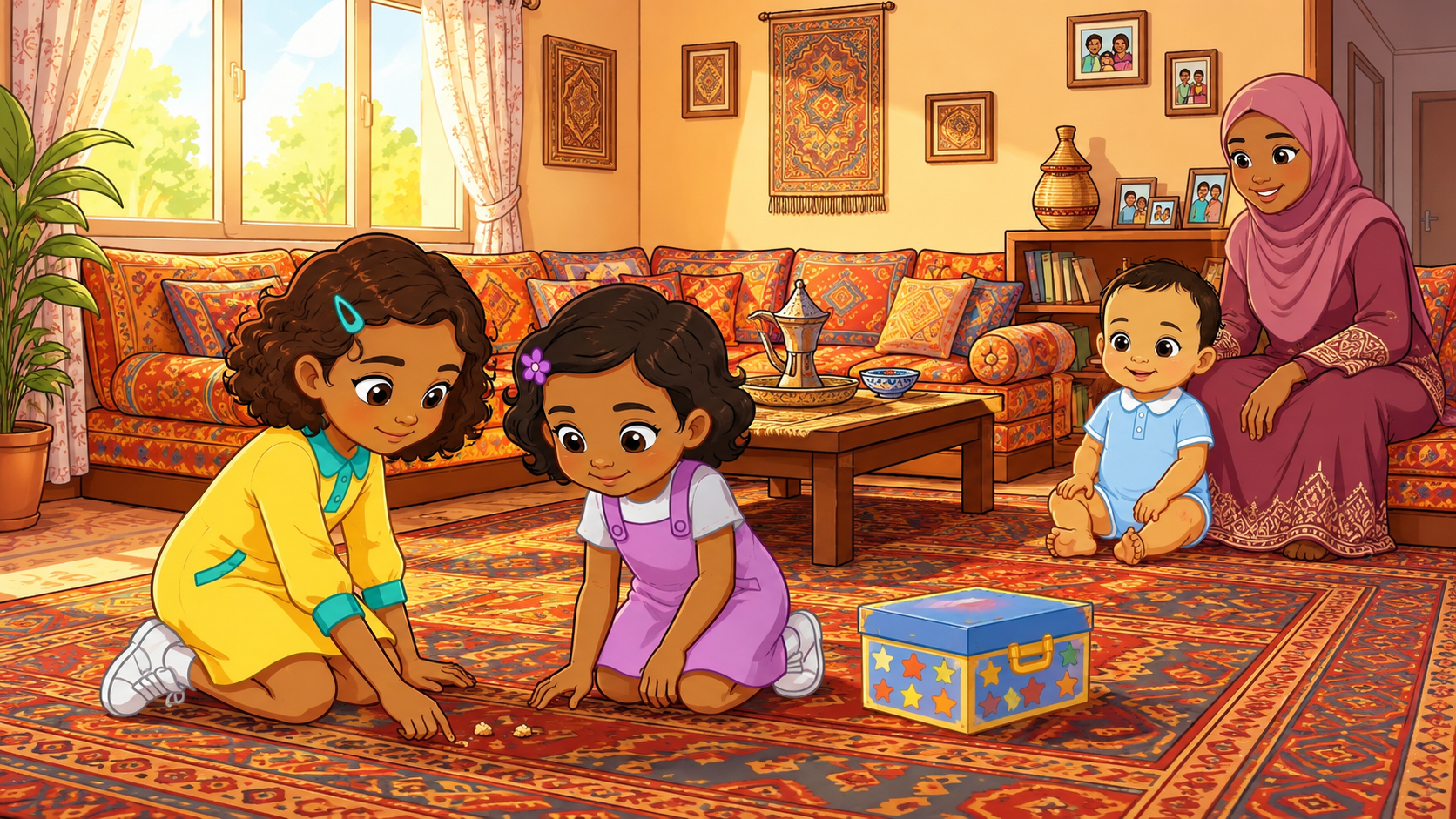
Muna and Amal spot a tiny mystery on the living-room rug and set out to work it out together.
Scene 2
1 shot · 8sShot 2 · close-up · 8s
Muna studies the crumbs as if they are an important clue, while Amal offers a silly explanation that turns the mystery into a joke.
- Amal: Maybe the toy box wanted a snack!
Scene 3
1 shot · 8sShot 3 · reaction · 8s
The sisters check the toy box together, and Adam’s harmless, curious intervention gives them a cheerful ending to their little mystery.
The story
Original input — click to expand
“MUNA & AMAL SEASON ONE — ANIMATION PRODUCTION GUIDE Little Adventures. Big Discoveries. 10 original episodes • approximately 3 minutes each • English dialogue with natural Somali words and cultural details Audience: preschool and early-primary children, approximately ages 3–7 This document brings the original Season One concept and episode stories into a production-ready plan. It incorporates the family-reference corrections: Muna and Amal are sisters; Adam is their baby brother and should resemble Muna more strongly. 1. The series at a glance Muna & Amal is a funny, warm, interactive preschool adventure-comedy about two curious sisters whose ordinary days turn into small mysteries, imaginative games and discoveries. Their baby brother Adam is part of the family and often adds a silent visual punchline. Ayeeyo and Hooyo bring warmth, family life and Somali cultural details into the stories. Folklore-inspired animal friends — Dawaco the fox, Diin the hedgehog and Bakayle the rabbit — create playful situations involving cleverness, curiosity and problem-solving. The show takes inspiration from broad storytelling qualities: playful chaos and memorable comedy, imaginative visual humour, and emotionally warm family relationships. The characters, stories, dialogue, designs, music and settings must remain original. Core promise to the audience Every episode starts with a funny surprise, a small problem or a mystery. Children are invited to look, count, compare, guess, remember or solve. The sisters try things, make mistakes, laugh and work together. The lesson is shown through the story, never delivered as a long lecture. A Somali word, family custom, food, setting or folklore reference appears naturally where it fits. 2. Character bible Important likeness instruction: use the two real family photographs supplied in the conversation as the primary visual references when generating the children. Do not use the earlier generic AI cartoon examples as likeness references. Text descriptions are only supporting guidance; the photographs should guide facial proportions, smiles, eye shape, hairline, hair texture, complexion and the sisters’ individual differences. Muna — older sister and little explorer She is a girl and the older of the two sisters. Use her own face and proportions from the supplied photographs; do not replace her with a generic “cartoon Somali girl.” Her hair is softer and finer than Amal’s, with a naturally soft appearance. Preserve the way it sits around her face in the references. Her complexion is a natural Somali maariin tone with warm, subtle golden/olive undertones, reflecting her Somali-Arab family heritage. Do not make her pale/white or very dark. Personality: observant, curious, imaginative, caring and confident. She likes to understand how things work and often takes the lead in a puzzle. Comedy: she can become overly serious about a tiny mystery, then be surprised by Amal’s silly solution. Suggested signature outfit: a sunny yellow dress or tunic with turquoise accents and comfortable white sneakers. Keep a small, recognisable hair accessory inspired by the family photo. Outfit is a character-design choice, not a claim about her real clothing. Amal — younger sister and comic spark She is also a girl. Do not depict Amal as a boy. Use Amal’s individual face from the supplied photographs. Preserve the real differences between her and Muna. Her hair is soft and dark, with slightly more defined loose curls than Muna’s. Avoid tight coils or exaggerated ringlets if they do not match the reference. Use the same natural Somali maariin complexion family range, with warm golden/olive undertones. Personality: energetic, funny, spontaneous, affectionate and imaginative. She often says the unexpected thing or misunderstands a clue in a funny way. Comedy: big reactions, funny logic, snack-related ideas, and confident statements that turn out to be completely wrong. Suggested signature outfit: lavender/pink coordinated dress or dungaree-style outfit with a white top and a purple flower accessory. Keep it simple enough to animate consistently. Adam — baby brother and silent scene-stealer Adam is the baby brother. His role is recurring and mostly visual rather than dialogue-heavy. He should resemble Muna more strongly than Amal, as the user specified. Use the baby’s own appearance from the first supplied photograph as the primary reference for his baby face, hair, proportions and expression. His complexion belongs to the same natural Somali-Arab family range. Personality on screen: curious, observant, cheerful, occasionally mischievous. He can crawl toward an important clue, giggle at the wrong moment, grab a harmless prop or reveal something the sisters missed. Suggested signature outfit: a soft baby-blue romper with white details. Keep all baby actions safe and age-appropriate. Never place Adam in danger for a joke; an adult should be nearby in family scenes. Ayeeyo —”
Make a film like this
Write a paragraph — TaleScene turns it into a voiced cartoon film with the same faces in every shot.