WHAT THE WAR LEFT BEHIND
The film
Storyboard
Scene 1
1 shot · 5sShot 1 · establishing · 5s
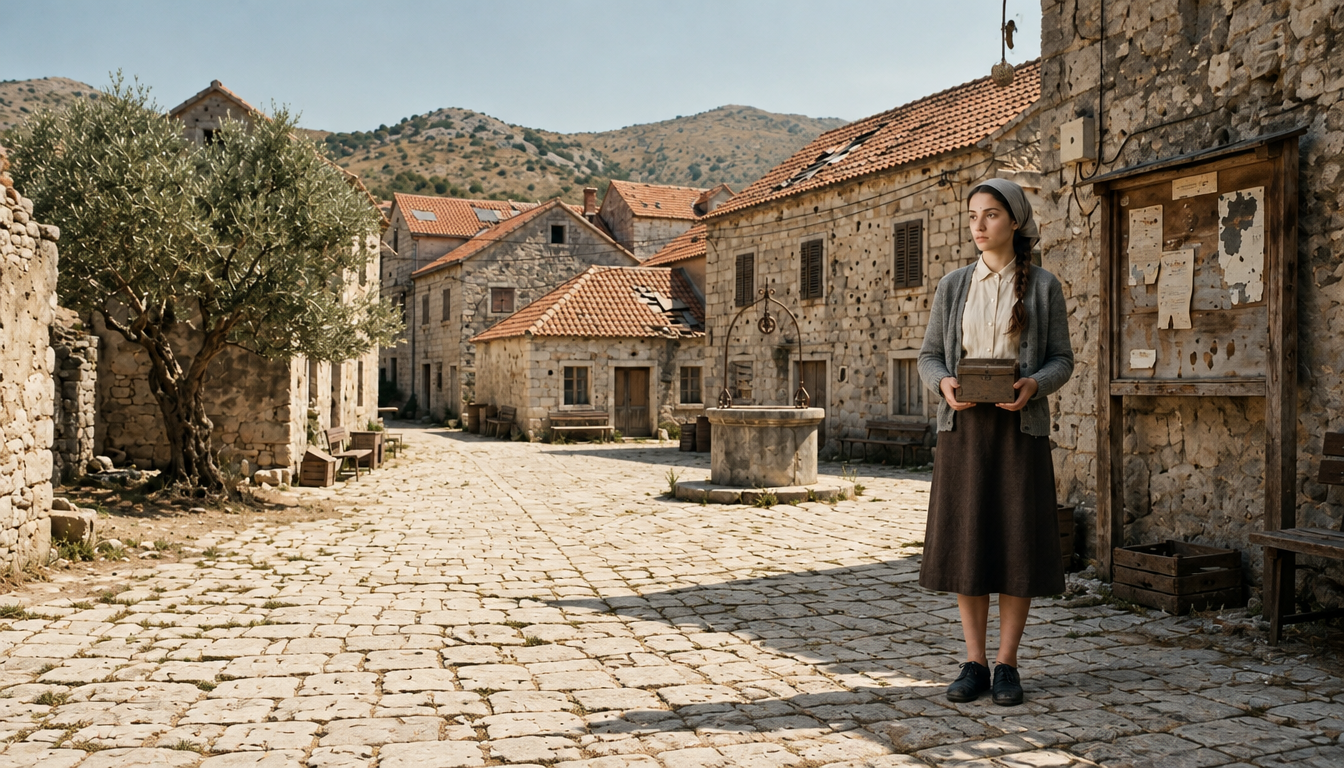
In 1945, Ruža stands in the scarred Dalmatian village square, trying to imagine where she belongs after the war. The empty space around her makes the absence of her murdered father feel larger than the village itself.
Scene 2
1 shot · 14sShot 2 · medium · 14s
Đorđe, a Serbian former partisan, enters Ruža's life in the same unsettled square. Their first exchange is cautious, but his willingness to stand beside her begins a love that will have to cross their different pasts and family histories.
- Đorđe: Are you looking for someone?
- Ruža: I am looking for the truth about my father.
- Đorđe: Then I will walk with you as far as I can.
Scene 3
1 shot · 12sShot 3 · medium · 12s
In early 1946, Ruža and Đorđe marry in the small Dalmatian home. Branka watches them begin a life marked by poverty, family responsibility, and the knowledge that love cannot erase their different experiences or the unanswered murder of Ante.
- Branka: There is little here, but it is ours to carry.
- Đorđe: We will make a home from what remains.
Scene 4
2 shots · 23sShot 4 · close-up · 13s
At the wooden table, Ruža confronts Ivan over the unopened paper and the missing answer about Ante.
- Ruža: Tell me who killed my father.
- Ivan: I cannot give you a name I do not know.
- Ruža: Then what was all of it for?
Shot 5 · medium close-up · 10s
Ivan offers no resolution, and Ruža leaves the evidence sealed beside the watch.
- Ivan: Some records disappear. Some choices stay with the people who made them.
Scene 5
1 shot · 12sShot 6 · wide · 12s
By 1950, Ruža and Đorđe are parents to Anđelina, Slavica, and Milan. Their home is poor and crowded, but the children's ordinary noise turns survival into a future they can see and touch.
- Ruža: Take it outside. There is more room in the light.
- Đorđe: And tomorrow we will find another way.
Scene 6
1 shot · 13sShot 7 · establishing · 13s
In 1956, the family moves to Belgrade. Ruža, Đorđe, their children, and infant Aleksandar enter a new apartment and a new routine, while a small Dalmatian object keeps their old home present.
- Đorđe: This city does not know us yet.
- Ruža: Then we will give it time to learn our names.
Scene 7
2 shots · 21sShot 8 · medium · 15s
Decades later, Ruža and Đorđe sit in their Belgrade living room as their children are adults and grandchildren have joined the family. The places of Belgrade, Buković, and Zadar connect the past to the present, while the war remains in memory even though it ended long ago.
- Ruža: We never found his name.
- Đorđe: No. But we found a way to keep living.
- Ruža: And they carried more than we wanted them to carry.
Shot 9 · medium close-up · 6s
Decades later, Ruža and Đorđe sit in their Belgrade living room as their children are adults and grandchildren have joined the family. The places of Belgrade, Buković, and Zadar connect the past to the present, while the war remains in memory even though it ended long ago.
- Đorđe: They also carried what we built.
Scene 8
1 shot · 9sShot 10 · wide · 9s
The final image returns to Dalmatia through Buković, where the family's memory and future meet. The war has not vanished from Ruža's life, and her father's murder remains unresolved, but the family has built love, home, and a new life beyond what was taken.
The story
Original input — click to expand
“WHAT THE WAR LEFT BEHIND “What the War Left Behind” is a historical family novel about love, loss, memories, and life continuing after great tragedies. The story begins in 1945 in Dalmatia, a region deeply scarred by war. Young Ruža, born in 1925, struggles to find her place in a world that has changed forever. Her family carries the pain of losing her father, Ante, whose murder remains unsolved. Đorđe, a Serbian man and former partisan born in 1913, enters her life. A love develops between them, becoming the foundation of their future together. However, their relationship cannot erase the differences in their life experiences, family relationships, and pasts.Ruža's mother, Branka, along with the people around them, tries to adapt to the new postwar circumstances. Ivan, Ruža's former love, is a man with a complicated past and morally difficult choices. His activities are connected to OZNA, the Yugoslav security agency, but the novel does not portray history as a simple division between good and evil. Other important characters include Mara, Novak, Danica, and Vjekoslav Josip Radić. Through their lives, the novel explores how war continues to influence human relationships long after the weapons have fallen silent.Ruža tries to discover the truth about her father's death. However, the answers she seeks never come. She must learn to live with the knowledge that some injustices remain unresolved. In early 1946, Ruža and Đorđe get married and begin their life together in postwar Dalmatia. Their everyday life is far from easy. It is marked by poverty, family responsibilities, social changes, and memories that still cause pain. The story then moves forward to 1950. Ruža and Đorđe are already parents, and their lives increasingly revolve around raising their children, caring for their family, and building a safer future.Their children, Anđelina, Slavica, Milan, and later Aleksandar, grow up in a world very different from the one their parents once knew. In 1956, the family moves to Belgrade, the capital of Yugoslavia. This move brings a new life, new opportunities, and changes to their everyday routines. Nevertheless, Dalmatia remains an important part of their identity and family memories. the decades pass, the children grow up, form their own relationships, and choose their own paths in life. The story gradually expands to follow their destinies and the next generation. In the later part of the novel, Ruža and Đorđe reflect on the life they have built together. Their children become adults, and grandchildren join the family. Belgrade, Buković, and Zadar remain places that connect the past with the present. The war ended long ago, but it has never disappeared from their memories. Ruža never discovers who murdered her father. The other characters also carry their own memories, decisions, and losses. Ultimately, the novel is not only about what the war took away from people, but also about what they managed to build afterward: love, family, a home, and a new life. “What the War Left Behind” is the story of a generation that survived the war and the generations that inherited its consequences.Step into an aura of dark allure.”
Make a film like this
Write a paragraph — TaleScene turns it into a voiced cinematic (live action) film with the same faces in every shot.